AI-Powered CRM in the UAE: How SMEs Automate Lead Follow-Up (and Stop Losing Deals)
How UAE SMEs use AI-powered CRM automation to capture every lead, respond instantly on WhatsApp and email, and stop deals going cold. A practical guide for Dubai & Sharjah businesses.
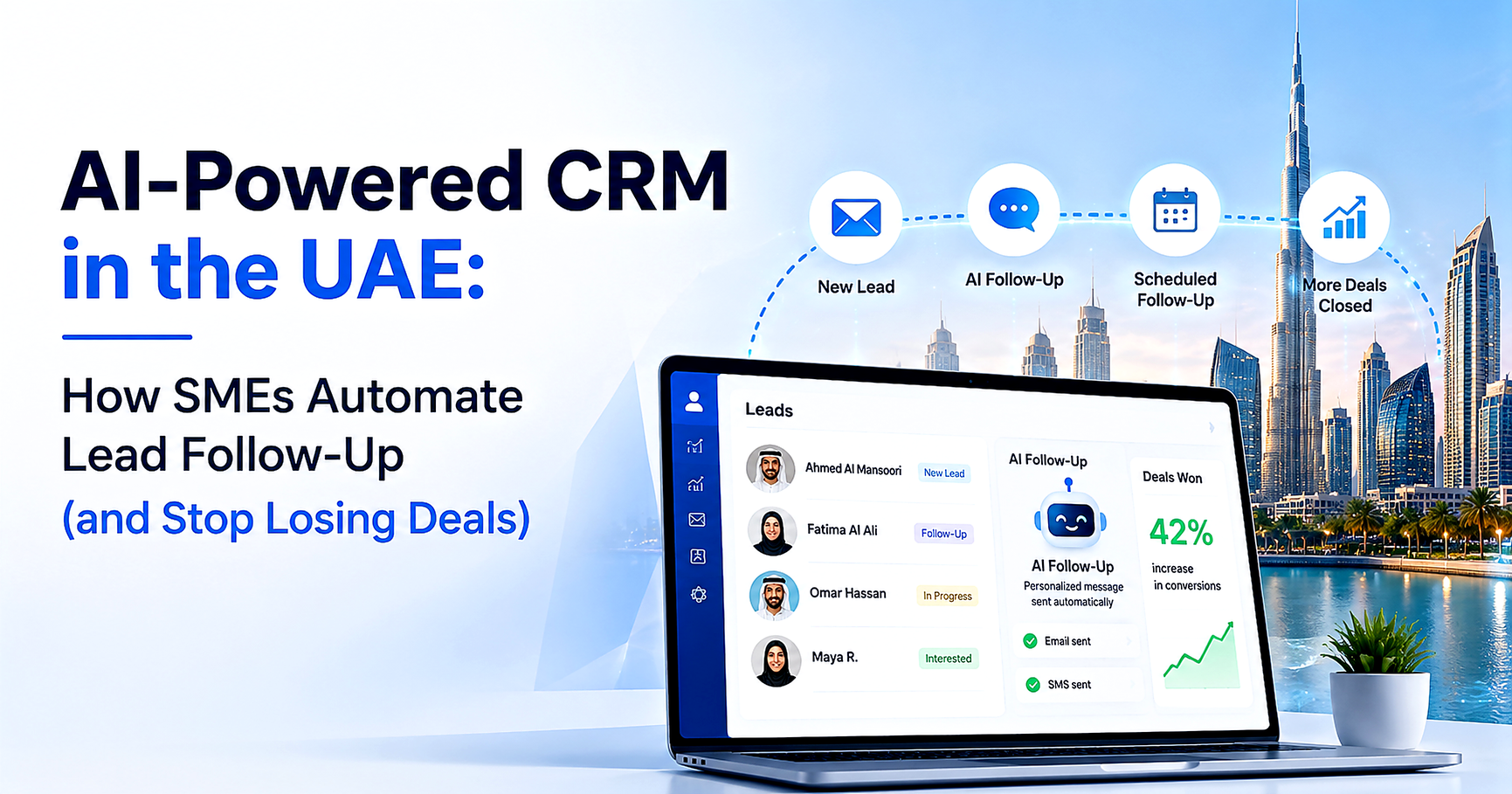
In the UAE, most B2B and service leads aren't lost because the price was wrong or the pitch fell flat. They're lost to silence — an enquiry lands in an inbox, WhatsApp, or a web form at 9pm, and by the time someone follows up two days later, the buyer has already spoken to three competitors. Speed is the whole game, and manual sales processes simply can't keep up.
That's the problem an AI-powered CRM is built to solve. Not by replacing your salespeople, but by removing the manual busywork that slows them down — the copying, the chasing, the "I'll get to it tomorrow" follow-ups that quietly leak revenue. Here's what that actually looks like for a small or growing business in Dubai, Sharjah, or Abu Dhabi.
Why manual CRM work costs UAE SMEs deals
Most SMEs here buy a capable CRM — HubSpot, Zoho, Salesforce, Pipedrive — and then run it by hand. Leads sit in personal inboxes. Someone forgets to log a call. A hot enquiry from a WhatsApp ad never makes it into the pipeline at all. The result is predictable:
- Slow first response. Studies across markets consistently show that responding within five minutes dramatically raises the odds of a conversation versus responding an hour later. In practice, most manual teams answer in hours or days.
- Leads that fall through the cracks. When capture depends on a person remembering to type, some percentage of every ad spend and marketing budget simply disappears.
- Reports that are always a day behind. If your pipeline is updated manually, your forecast is a guess — and you find out about a stalled deal after it's already dead.
None of this is a people problem. It's a process problem, and process problems are exactly what automation fixes.
What "AI-powered CRM" actually means (without the hype)
The phrase gets thrown around loosely, so let's be concrete. An AI-powered CRM isn't a new piece of software you have to migrate to. It's a layer of automation and AI agents that sit on top of the CRM you already use, handling the repetitive judgement-and-typing work a human would otherwise do. The AI part reads incoming messages, understands intent, drafts context-aware replies, and routes the right lead to the right person. The automation part makes sure it all happens instantly, every time, without anyone remembering to press a button.
Five automations that move the needle
You don't need to automate everything on day one. In our experience, these five deliver the fastest return for a UAE SME:
1. Automated lead capture from every channel
Every enquiry — website form, WhatsApp, Instagram, Google ads, landing pages — lands in your CRM instantly, tagged by source, deduplicated, and assigned to the right rep. Nothing depends on someone copying details across by hand.
2. Instant first response
The moment a lead comes in, an AI agent sends a relevant, personalised acknowledgement — in English or Arabic — so the buyer knows they've been heard while your team is asleep, on-site, or with another client. This single automation often has the biggest impact on conversion, because it wins the race that speed decides.
3. Smart follow-up sequences
Instead of a rep trying to remember who to chase, follow-ups fire on the right trigger across email and WhatsApp — the two channels UAE buyers actually respond to. Sequences adapt to how the lead behaves, and they stop the moment a human takes over, so nothing feels robotic.
4. Self-maintaining pipeline hygiene
Deal stages update themselves based on real activity — a reply received, a proposal opened, a meeting booked — instead of relying on reps to keep the board tidy. Your pipeline reflects reality, not wishful thinking.
5. Real-time reporting
With capture and stage updates automated, dashboards refresh on their own. You get accurate forecasting and can spot a stalling deal while there's still time to save it — without chasing your team for updates every Sunday.
What to look for in a UAE context
Automation that works in another market won't automatically fit here. A few things matter specifically for the Emirates:
- WhatsApp-first. In the Gulf, WhatsApp isn't a "nice to have" — it's often the primary sales channel. Any serious CRM automation has to treat it as a first-class citizen, not an afterthought.
- Arabic and English. Auto-responses and follow-ups should handle both naturally, so you're not alienating half your market.
- Works with your existing CRM. You shouldn't have to rip out and replace a system your team already knows. The right approach orchestrates on top of it.
- Data control. Automation logic that runs on secure, self-hosted infrastructure (rather than scattered across third-party SaaS you can't audit) keeps your customer data where you can govern it.
How to get started
The mistake most teams make is trying to boil the ocean. Start with the one automation that maps to your biggest leak — usually instant response and follow-up — prove the lift, then expand into pipeline and reporting. Because these workflows sit on top of your current CRM, you can roll them out incrementally without disrupting how your team already sells.
If you'd like to see exactly which parts of your sales process can run themselves, our CRM automation service for UAE businesses maps your lead flow end to end and automates the busywork — connected to the CRM you already use. It's the fastest way to stop losing deals to silence and turn your CRM into a system that sells while you sleep.

Written by
Sachin Chandramohanan
Founder & CEO, Daanbi Services
Sachin Chandramohanan is the founder of Daanbi Services, a UK-based technology company helping SMEs across the UK, USA and UAE build, automate and scale with AI-driven software and automation.
Connect on LinkedIn arrow_outward